What the Bible Really Says About Christian Unity
Christian unity is not a modern idea or a compromise — it is a biblical command. Here is what Scripture actually teaches about the oneness of the Body of Christ.

There is a version of "Christian unity" that gets dismissed quickly — and rightly so. It is the kind that asks believers to set aside their convictions, blur theological distinctions, and agree that all paths lead to the same place. That is not unity. That is compromise.
But there is another kind of unity — the kind the New Testament actually describes — that has nothing to do with compromise and everything to do with Christ. This is the unity that Paul commands, that Jesus prayed for, and that the early Church embodied. And it is far more radical, and far more attainable, than most Christians realize.
Unity Is Not Uniformity
The first thing to understand about biblical unity is what it is not.
Unity is not uniformity. The New Testament Church was not a monolithic institution with identical worship styles, identical governance structures, and identical cultural expressions. It was a diverse, geographically scattered, culturally varied movement of people who shared one Lord, one faith, and one baptism.
The church in Jerusalem looked different from the church in Corinth. The church in Antioch looked different from the church in Rome. They had different leaders, different challenges, different cultural contexts. And yet Paul could write to all of them as members of one Body.
The diversity was not a problem. It was a reflection of the God who created every tribe, tongue, and nation and called all of them to Himself.
What the New Testament does not describe — and what Paul consistently pushes back against — is division. Not diversity, but division. Not difference, but the kind of difference that becomes a wall.
What Paul Taught About the Body
The most extended treatment of Christian unity in the New Testament is found in Paul's letters, particularly Ephesians and 1 Corinthians. What he describes is not a vague aspiration. It is a theological reality with practical implications.
One Body, One Spirit
"There is one body and one Spirit, just as you were called to one hope when you were called; one Lord, one faith, one baptism; one God and Father of all, who is over all and through all and in all." — Ephesians 4:4–6
Paul's sevenfold "one" is not rhetorical decoration. It is a theological statement: the unity of the Church is grounded in the unity of God Himself. There is one Father, one Lord, one Spirit — and therefore one Body.
This means that Christian unity is not something we create. It is something that already exists in Christ. Our calling is not to manufacture unity but to maintain it: "Make every effort to keep the unity of the Spirit through the bond of peace." (Ephesians 4:3)
The word translated "keep" (Greek: tēreō) means to guard, to protect, to preserve. Unity is a gift that can be damaged. Paul's command is to protect it.
Many Members, One Body
In 1 Corinthians 12, Paul develops the metaphor of the Body in detail. His point is that diversity within the Body is not a threat to unity — it is essential to it.
"Just as a body, though one, has many parts, but all its many parts form one body, so it is with Christ." (1 Corinthians 12:12)
The eye cannot say to the hand, "I don't need you." The head cannot say to the feet, "I don't need you." Every member is necessary. Every gift is given for the common good (1 Corinthians 12:7).
When denominations operate as if they are complete in themselves — as if they have no need of the gifts and insights that other parts of the Body carry — they are acting against the very design of the Body Paul describes.
The Warning Against Division
Paul did not treat division in the Church as a minor inconvenience. He treated it as a serious spiritual problem.
In 1 Corinthians 1:10–13, he confronts the Corinthian church directly: "I appeal to you, brothers and sisters, in the name of our Lord Jesus Christ, that all of you agree with one another in what you say and that there be no divisions among you, but that you be perfectly united in mind and thought."
The Corinthians were dividing along lines of loyalty to different teachers — Paul, Apollos, Cephas. Paul's response was not to validate the divisions or to say that each group had a point. His response was to ask a pointed question: "Is Christ divided?"
The answer, of course, is no. And that answer is meant to expose the absurdity of the divisions. If Christ is not divided, then a Church that divides itself in His name is acting against its own nature.
What Jesus Prayed For
The most profound statement on Christian unity in all of Scripture is found in John 17 — the prayer Jesus prayed for His disciples and for all future believers on the night of His arrest.
"My prayer is not for them alone. I pray also for those who will believe in me through their message, that all of them may be one, Father, just as you are in me and I am in you. May they also be in us so that the world may believe that you have sent me." — John 17:20–21
Three things stand out in this prayer.
First, the scope. Jesus was not praying only for the eleven disciples in the room. He was praying for every person who would ever believe in Him through their message — which includes every Christian who has ever lived, and every Christian alive today. This prayer is for us.
Second, the standard. The unity Jesus prayed for is modeled on the unity between the Father and the Son. That is not a low bar. It is the highest possible standard of relational unity — complete, unbroken, mutual indwelling. Jesus did not pray for organizational cooperation. He prayed for something that can only be produced by the Spirit of God.
Third, the purpose. Jesus connected the unity of the Church to the credibility of the Gospel: "so that the world may believe that you have sent me." The unity of the Church is not just an internal matter. It is a witness to the world. When the Church is visibly united, it testifies to the reality of Christ. When it is visibly divided, it undermines that testimony.
Unity and Truth Are Not Opposites
One of the most common objections to the call for Christian unity is that it requires compromising on truth. If we pursue unity, the argument goes, we will have to water down our convictions.
This objection misunderstands what biblical unity actually requires.
Paul's call to unity in Ephesians 4 is immediately followed by a call to maturity — to "no longer be infants, tossed back and forth by the waves, and blown here and there by every wind of teaching." (Ephesians 4:14) Unity is not achieved by abandoning theological discernment. It is achieved by growing into the fullness of Christ together.
The unity Paul describes is "unity in the faith and in the knowledge of the Son of God." (Ephesians 4:13) It is a unity that is grounded in truth, not one that sacrifices it.
There are genuine theological differences among Christians that matter and should be taken seriously. The question is whether those differences are sufficient grounds for treating other believers as outsiders — for refusing to worship alongside them, learn from them, or call them brothers and sisters in Christ.
For most of the denominational divisions that mark the modern Church, the honest answer is no.
The Practical Call
Biblical unity is not an abstract ideal. It has practical implications for how we live as believers and how we relate to the broader Body of Christ.
Pray for the whole Church, not just your corner of it. When you pray for the Church, include believers in traditions very different from your own. Ask God to bless them, to strengthen them, to use them for His Kingdom.
Receive teaching from across the Body. Some of the most faithful Bible teachers in history have come from traditions different from yours. Read them. Listen to them. Let the whole Body teach you.
Resist the impulse to define yourself against other Christians. It is easy to build an identity around what you are not — not Catholic, not Pentecostal, not liberal. But an identity built on negation is a thin identity. Build yours on Christ.
Ask the hard question. Is the label you carry serving the Gospel, or is it getting in the way? Is it helping you love other believers more fully, or is it giving you permission to love them less?
These are not comfortable questions. But they are the questions that the New Testament presses us toward.
Going Deeper
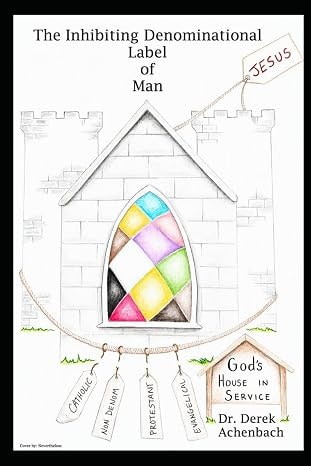
If you want to explore these themes further — the biblical case for unity, the history of how denominational labels developed, and what it might look like to move beyond them — Dr. Derek Achenbach's book The Inhibiting Denominational Label of Man is a thorough and pastoral guide.
Get your copy on Amazon this September and bring the conversation to your church, your small group, or your own study.
The Body of Christ was never meant to be this divided. And the good news is that the unity Christ prayed for is not out of reach — it is already ours in Him. We just have to be willing to live like it.
Explore Topics

Written by
Dr. Derek Achenbach
Shepherd & Founder · God's House Ministries · Phoenix, AZ
Dr. Derek Achenbach (Derek Randall Achenbach) is the Shepherd and founder of God's House Ministries, a non-denominational adult Christian church in Phoenix, Arizona. He is a Bible teacher, pastor, and author devoted to helping believers move beyond religious labels and discover their true identity in Christ. He is the author of The Inhibiting Denominational Label of Man, available on Amazon.