Why the Church Must Move Beyond Denominational Labels
Denominational labels have shaped Christianity for centuries — but are they helping or hindering the unity Christ prayed for? A biblical look at what the labels are costing us.

Walk into any city in America and you will find dozens of churches within a few miles of each other — Baptist, Methodist, Pentecostal, Catholic, non-denominational, and everything in between. Each one carries a label. Each label carries a history. And somewhere along the way, those labels became walls.
This is not a small problem. It is one of the most significant barriers to the kind of unity Christ prayed for the night before He went to the cross. And if we are honest with ourselves, most of us have never stopped to ask whether the labels we carry are helping or hurting the mission of the Church.
What Is a Denominational Label?
A denominational label is more than a name on a sign. It is a statement of identity — a declaration of what you believe, how you worship, and who you consider to be "your people." Labels like Baptist, Pentecostal, or Catholic carry centuries of theological tradition, cultural history, and institutional structure.
None of that is inherently wrong. Tradition can be a gift. History can be a teacher. Structure can be a servant.
But labels have a way of becoming something more than descriptors. They become dividers.
When a label tells you who is in and who is out — when it shapes your willingness to worship alongside another believer, to receive their teaching, or to call them brother or sister — it has crossed a line. It has become an inhibiting label.
What Jesus Prayed For
In John 17, on the night of His arrest, Jesus prayed for His disciples and for all who would believe through their message. His prayer was not for doctrinal uniformity. It was not for institutional alignment. It was for unity.
"I pray also for those who will believe in me through their message, that all of them may be one, Father, just as you are in me and I am in you." — John 17:20–21
The standard Jesus set was not organizational. It was relational — the same kind of unity that exists between the Father and the Son. That is a staggering standard. And it is the one He prayed for.
When we look at the fragmented landscape of modern Christianity, we have to ask: how far are we from that prayer being answered?
The Cost of the Labels
Denominational labels carry real costs — costs that are rarely counted because they have become so normalized.
They divide the Body. Paul addressed this directly in 1 Corinthians 1:12–13: "One of you says, 'I follow Paul'; another, 'I follow Apollos'; another, 'I follow Cephas'; still another, 'I follow Christ.' Is Christ divided?" The names have changed, but the dynamic has not. When believers identify primarily with a denomination rather than with Christ, the Body is divided.
They create in-group loyalty over Kingdom loyalty. When your primary allegiance is to your denomination, you will naturally prioritize its interests, its survival, and its reputation over the broader work of the Kingdom. Resources, energy, and influence that could serve the whole Body get funneled into institutional preservation.
They confuse the watching world. Jesus said the world would know His disciples by their love for one another (John 13:35). When the Church is visibly fragmented — when denominations compete, criticize, and separate from one another — it sends a message that contradicts the Gospel.
They can become a substitute for the Spirit. When identity is rooted in a label rather than in a living relationship with Christ, the label can become a false security. You can be thoroughly Baptist or thoroughly Pentecostal and still be far from God.
What Scripture Actually Teaches About Unity
The New Testament does not describe a Church organized around denominations. It describes a Church organized around Christ.
Paul's letter to the Ephesians is perhaps the clearest articulation of what the Church is meant to be: "There is one body and one Spirit, just as you were called to one hope when you were called; one Lord, one faith, one baptism; one God and Father of all, who is over all and through all and in all." (Ephesians 4:4–6)
One body. One Spirit. One Lord. One faith. One baptism. One God.
The repetition is not accidental. Paul is making a point: the Church's unity is not something we create. It is something we are called to maintain (Ephesians 4:3). The unity already exists in Christ. Our job is not to manufacture it but to protect it.
Denominational labels, at their worst, do the opposite. They fracture what Christ has already made one.
The Difference Between Diversity and Division
It is important to be clear here: the call to move beyond denominational labels is not a call to uniformity. The Body of Christ is meant to be diverse. Different gifts, different expressions of worship, different cultural contexts — these are not problems to be solved. They are features of a Body that reflects the fullness of God.
The issue is not diversity. The issue is division.
Diversity says: we are different, and that is good. Division says: we are different, and therefore separate. Diversity enriches the Body. Division weakens it.
A church that worships with expressive praise and a church that worships with quiet reverence can both be fully submitted to the same Spirit. A congregation that baptizes infants and one that baptizes only believers can both be reading the same Scripture with sincere hearts. These differences do not have to be walls.
The question is whether we are willing to hold our traditions with open hands — to say, "This is how we understand and practice our faith," without adding, "and therefore you are less than."
Moving Forward Without Losing Your Roots
Moving beyond denominational labels does not mean abandoning your history or your theological convictions. It means holding them in their proper place — as servants of the Gospel, not masters of it.
Here are three practical shifts that can begin to move a believer, and a congregation, in the right direction:
1. Lead with Christ, not with your tradition. When you introduce yourself as a follower of Jesus rather than as a Baptist or a Pentecostal, you are making a statement about where your primary identity lies. This is not about hiding your background. It is about leading with what matters most.
2. Seek fellowship across denominational lines. Make a deliberate effort to worship, pray, and serve alongside believers from different traditions. You will find more common ground than you expect — and the differences you do encounter will sharpen your own understanding of Scripture.
3. Read the Word for yourself. Many denominational distinctives are the result of tradition being passed down without being tested against Scripture. When you read the Bible with fresh eyes, asking "What does this actually say?" rather than "What does my tradition say about this?", you may find that some of the walls you have inherited are not as solid as you thought.
The Invitation
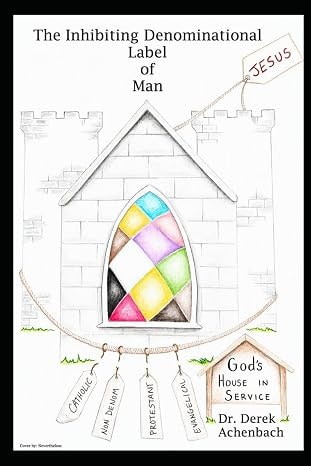
The message of The Inhibiting Denominational Label of Man is not a message of criticism. It is a message of invitation — an invitation to return to the simplicity and power of a Church united around Christ.
The labels have been with us for a long time. They will not disappear overnight. But the conversation has to start somewhere.
If you have ever felt the tension between your denominational identity and your desire for genuine unity with other believers, this book was written for you. If you have ever wondered whether the divisions in the Church are as inevitable as they seem, this book was written for you.
Get your copy of The Inhibiting Denominational Label of Man on Amazon and join the conversation that the Body of Christ needs to have.
Explore Topics

Written by
Dr. Derek Achenbach
Shepherd & Founder · God's House Ministries · Phoenix, AZ
Dr. Derek Achenbach (Derek Randall Achenbach) is the Shepherd and founder of God's House Ministries, a non-denominational adult Christian church in Phoenix, Arizona. He is a Bible teacher, pastor, and author devoted to helping believers move beyond religious labels and discover their true identity in Christ. He is the author of The Inhibiting Denominational Label of Man, available on Amazon.